
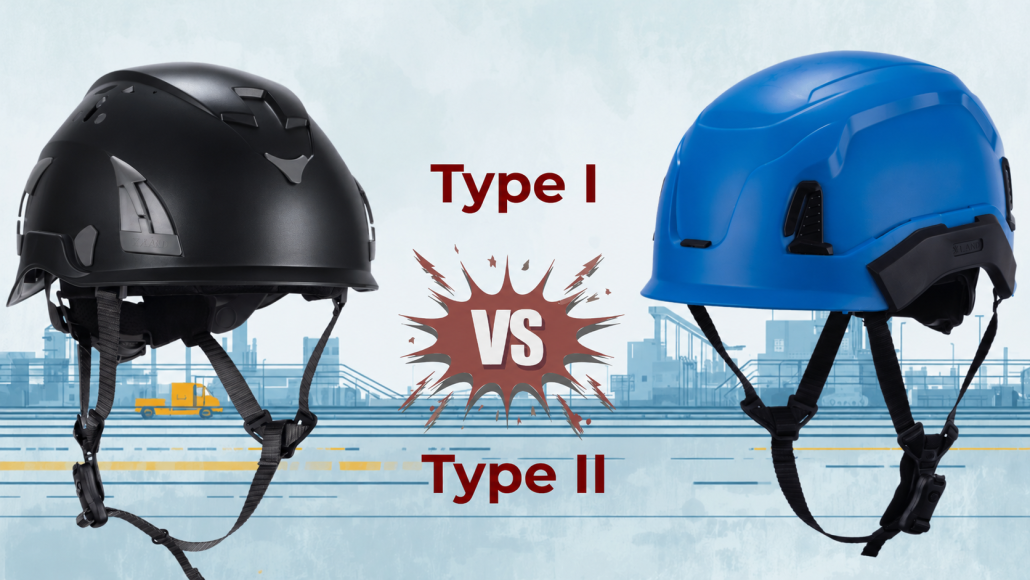
Type I vs. Type II Safety Helmets
What’s the Difference, and Which One Do You Need?
Not all safety helmets protect against the same types of impact. Do you know the difference?
When choosing a safety helmet, it’s easy to focus on the obvious details—weight, ventilation, comfort, appearance, or price.
But there’s something more important to understand first: Where is the helmet designed to provide impact protection?
That’s where Type I and Type II safety helmets come in.
Under the ANSI/ISEA Z89.1 standard, these two classifications have different impact-performance requirements. Understanding them is essential whether you’re purchasing safety helmets, expanding your PPE product line, or developing helmets under your own brand.
At Aurora Sports, we work with helmet brands, importers, and distributors on private-label, OEM, and ODM industrial safety helmet projects.
Let’s look at the differences, what they mean for your customers, and why choosing the right helmet type matters before manufacturing begins.
Type I vs. Type II Safety Helmets: Quick Comparison
| Feature | Type I Safety Helmet | Type II Safety Helmet |
|---|---|---|
| Impact protection | Primarily top of the head | Top and lateral areas |
| Top-impact testing | Required | Required |
| Top penetration testing | Required | Required |
| Lateral impact testing | Not required | Required |
| Off-center penetration testing | Not required | Required |
| Common applications | Workplaces with primarily overhead impact hazards | Workplaces with identified top, side, or off-center impact hazards |
| Main advantage | Top-impact protection | Additional impact protection around the head |
The key takeaway: Type II provides additional impact protection, but that doesn’t mean every workplace automatically needs a Type II helmet. The right choice depends on the hazards your customers face.
What Is a Type I Safety Helmet?
A Type I hard hat, also known as a Type I safety helmet, is designed primarily to reduce impact forces from blows to the top of the head.
Think about a construction worker exposed to falling tools or materials from above. Overhead impact hazards are one of the main reasons Type I helmets are commonly used.
Where Are Type I Helmets Commonly Used?
Depending on the workplace hazard assessment, Type I helmets may be appropriate for:
- General construction
- Manufacturing facilities
- Warehouses and logistics
- Road construction
- Outdoor maintenance
- Industrial operations with primarily overhead impact hazards
What Should Helmet Brands Consider?
For brands developing a Type I helmet product line, customer preferences may include:
- Lightweight construction
- Ventilation and airflow
- Comfortable suspension systems
- Easy ratchet adjustment
- Chin straps, where appropriate
- Compatible visors and hearing protection
- Custom colors, logos, and packaging
At Aurora Sports, we help customers explore these features based on the selected helmet platform, intended application, and applicable safety requirements.
The goal isn’t simply to offer more features. It’s to offer the right combination for the people wearing the helmet.
 What Is a Type II Safety Helmet?
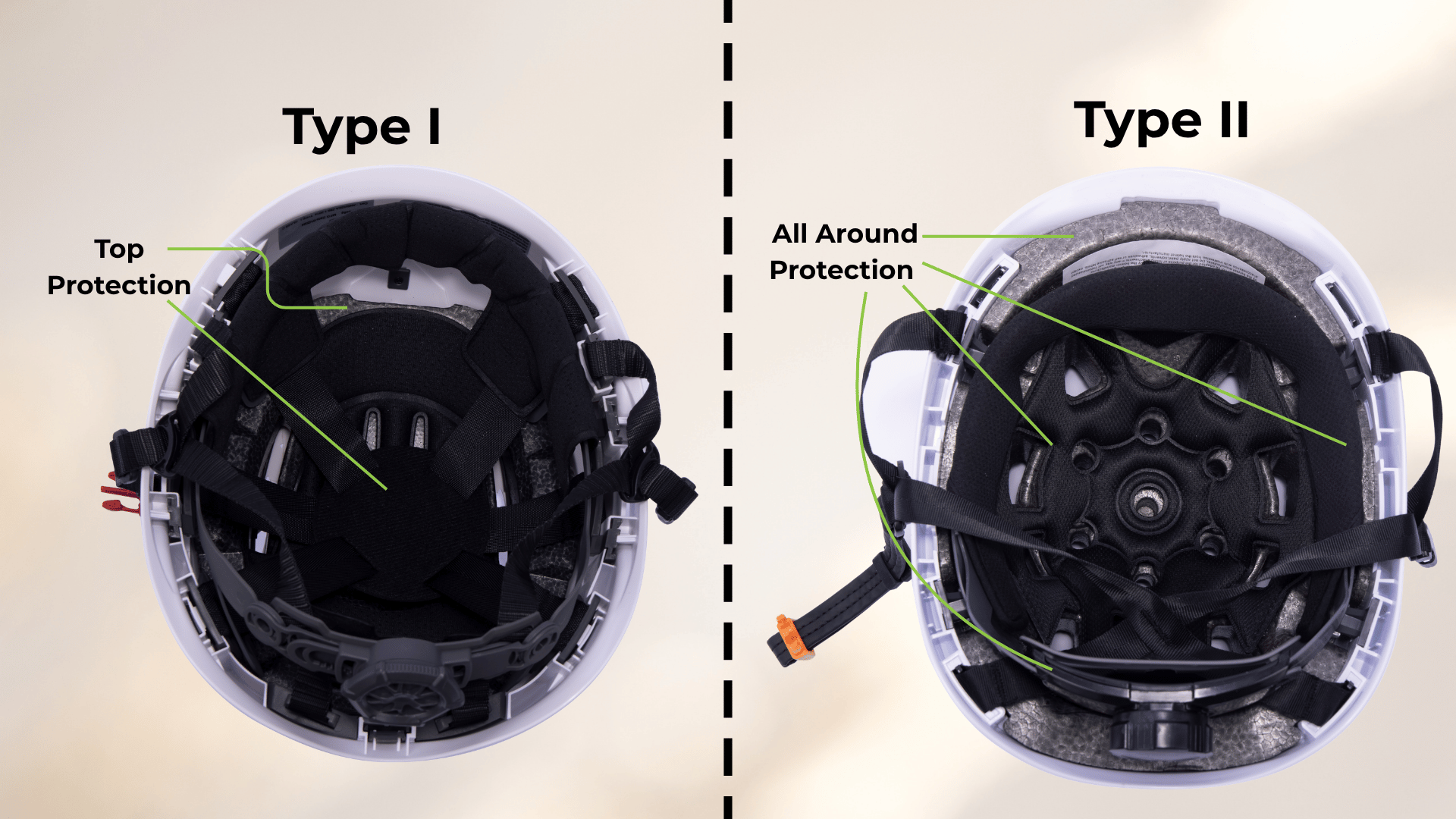
A Type II safety helmet meets additional impact-performance requirements beyond those of Type I helmets.
In addition to top-impact protection, Type II helmets undergo testing for lateral impact-energy attenuation and off-center penetration.
This means Type II helmets are evaluated for impacts involving areas around the front, back, and sides of the head.
When Might Type II Protection Be Important?
Consider workplaces where workers may face more than falling objects from above.
Potential hazards can include:
- Contact with moving equipment
- Vehicle and machinery operations
- Work at height
- Confined or restricted spaces
- Slips, trips, and falls
- Situations involving possible side or off-center head impacts
For these environments, employers may determine that Type II head protection is appropriate based on their hazard assessments.
However, no safety helmet eliminates every risk of head injury. Proper selection, fit, and use remain essential.
What Does This Mean for Helmet Development?
Type II performance can influence how the helmet is engineered.
Manufacturers may need to consider shell geometry, impact-absorbing liners, coverage, fit systems, and the interaction between different components.
This is why Type II is not simply a Type I helmet with extra padding.
The entire helmet configuration must meet the applicable performance requirements.
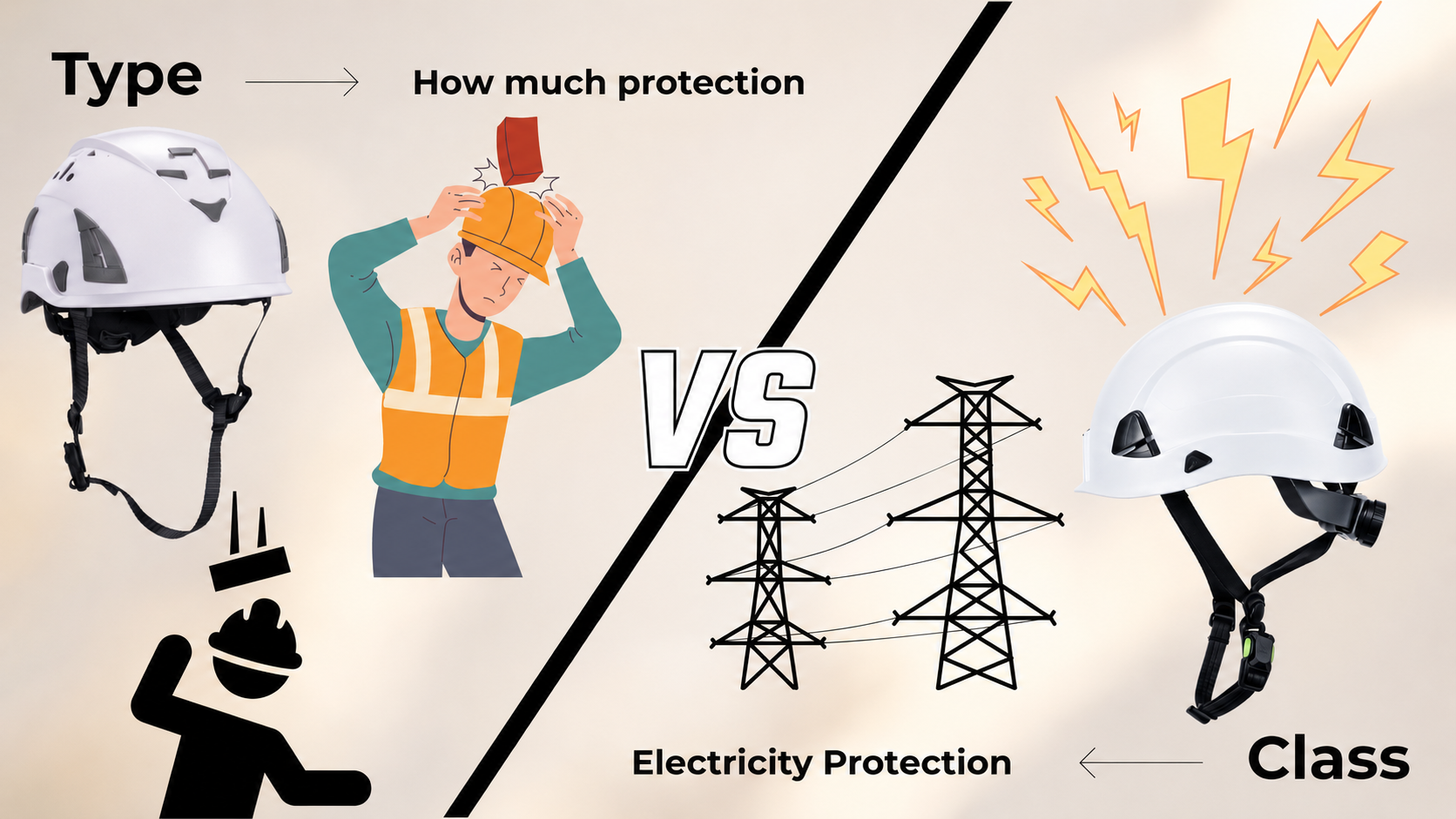
Type I vs. Type II Is Not the Same as Class C vs. Class E
This is one of the most common areas of confusion when sourcing industrial safety helmets.
Helmet Type describes impact protection.
- Type I: Primarily top-impact protection
- Type II: Top and lateral-impact protection
Helmet Class describes electrical protection.
- Class C: No electrical protection
- Class G: General electrical protection
- Class E: Higher electrical-protection requirements
A helmet can be Type I Class C, Type I Class E, Type II Class C, or Type II Class E, depending on its tested configuration.
For example, a Type II helmet does not automatically provide electrical protection. That depends on its electrical classification.
If you’re unsure how electrical classifications work, read our related guide:
Class C vs. Class E Safety Helmets: What’s the Difference?
Understanding both Type and Class is especially important for brands developing helmets for different industries and markets.
Is a Type II Helmet Always Better Than Type I?
It’s tempting to assume that Type II must be the better choice because it has additional impact-performance requirements.
But the answer isn’t quite that simple.
The best helmet is the one that matches the hazards of the intended workplace.
Type II offers additional tested impact protection, while Type I may still be suitable for environments where the identified hazards primarily involve overhead impacts.
Buyers should also evaluate:
- Electrical classification
- Helmet fit and stability
- Weight and wearer comfort
- Ventilation requirements
- Retention and chin-strap needs
- Compatible accessories
- Applicable safety standards
- The intended work environment
For PPE brands and distributors, understanding these differences helps you recommend the right product rather than simply promoting the most expensive option.
Good product selection starts with understanding the customer—not just comparing specifications.
Can You Turn a Type I Helmet Into Type II by Adding Padding?
This is an important question, especially for companies exploring custom helmet manufacturing.
The short answer is no—not without proper engineering and testing.
Adding thicker padding, an EPS liner, or a chin strap does not automatically make a Type I helmet compliant with Type II requirements.
Developing a Type II helmet may involve changes to:
- Shell shape and construction
- Impact-absorbing liner design
- Material thickness and density
- Helmet coverage
- Suspension and retention systems
- Injection molds and tooling
- Testing and certification plans
Even seemingly small design changes can affect the helmet’s overall performance.
At Aurora Sports, our injection molding and product development capabilities support the engineering and manufacturing process for custom helmet projects.
Our advice to helmet brands: Decide on the required Type and Class before investing in tooling or major customization.
Making these decisions early can help reduce unnecessary redesigns, additional testing costs, and production delays.
Looking for a Type I or Type II Safety Helmet Manufacturer?
Understanding the difference is one thing. Finding the right manufacturing partner is another.
If you’re planning to introduce a new safety helmet product line, you may be wondering:
Do we need to develop an entirely new helmet? Can we customize an existing model? How much flexibility do we have with components, colors, and accessories?
At Aurora Sports, we help customers explore different manufacturing approaches based on their product goals, target markets, and order requirements.
Private-Label Safety Helmets: Build Your Brand Without Starting From Scratch
If you want to introduce safety helmets under your own brand, an existing helmet platform may be a practical starting point.
Depending on the model, available customization may include logos, colors, packaging, and approved accessories.
This can help established brands and distributors expand their product lines without taking on the full cost of developing a completely new helmet.
ODM Safety Helmet Development: Customize an Existing Platform
Have a specific market in mind but need help developing the right configuration?
Aurora Sports can work with customers to evaluate available helmet platforms, component options, and feasible design modifications.
Engineering, tooling, testing, and production requirements depend on the scope of customization.
OEM Safety Helmet Manufacturing: Bring Your Own Design
Already have a helmet concept, technical drawings, or product specifications?
Our team can review the project and evaluate manufacturing feasibility, tooling requirements, component production, and assembly planning.
For projects requiring new tooling or a new helmet design, development costs, testing requirements, and minimum order quantities must be considered.
Why Work With Aurora Sports?
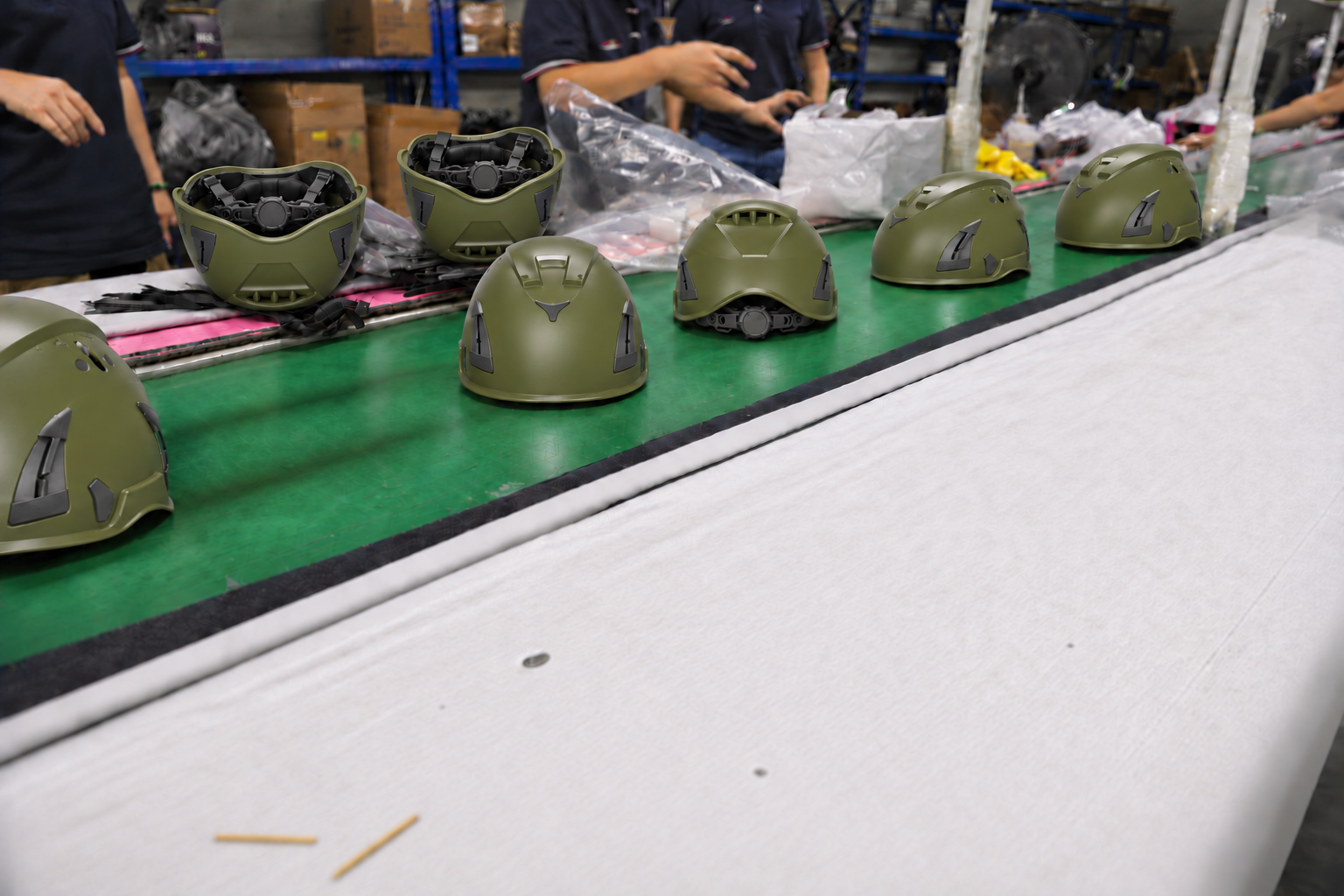
Developing a safety helmet involves much more than producing a plastic shell.
Shells, liners, suspension systems, ratchets, buckles, chin straps, padding, and accessories all need to work together as a complete product.
And if you’re building your own helmet brand, coordinating these details across multiple suppliers can quickly become complicated.
That’s where having an experienced manufacturing partner can make a difference.
Aurora Sports can help coordinate key stages of the project:
Product Requirements → Engineering → Prototyping → Tooling → Testing Support → Manufacturing → Assembly → Quality Control → Packaging
Through our helmet manufacturing and assembly services, we help customers manage product development and production requirements through one team.
For your business, that means:
- Less Sourcing Hassle: Work with one manufacturing partner instead of coordinating multiple component suppliers.
- More Customization Options: Explore helmet colors, branding, fit systems, compatible accessories, and packaging.
- Factory-Direct Cost Advantages: Work directly with the manufacturing team to evaluate practical production options and manage costs.
- A More Efficient Development Process: Identify design, tooling, and testing requirements earlier.
- More Time to Grow Your Brand: Focus on your customers and sales channels while we help coordinate manufacturing.
All available options depend on the selected helmet platform, project specifications, production quantities, and applicable testing requirements.
Frequently Asked Questions About Type I and Type II Helmets
- What is the biggest difference between Type I and Type II hard hats?
Type I helmets are primarily designed for top-impact protection. Type II helmets must meet additional requirements for lateral impacts and off-center penetration. - Is Type II required by OSHA?
OSHA requires employers to select appropriate head protection based on workplace hazards and applicable requirements. Type II helmets are not automatically required for every job. Employers should evaluate the actual risks and applicable regulations. - Does adding a chin strap make a Type I helmet Type II?
No. A chin strap may help with helmet retention, but it does not establish Type II impact performance. - Are all climbing-style safety helmets Type II?
No. A helmet’s appearance does not determine its ANSI classification. Always check the product markings and applicable testing or certification documentation. - Is a Type II helmet automatically Class E?
No. Type II describes impact protection, while Class E describes electrical protection. These are separate classifications. - Can Aurora Sports manufacture custom Type I and Type II helmets?
Aurora Sports can evaluate private-label, OEM, and ODM projects involving Type I and Type II industrial safety helmets. Available configurations and customization options depend on the selected platform, engineering feasibility, and applicable testing requirements.
Which Safety Helmet Should Your Brand Offer?
Before selecting a helmet, ask yourself:
Who are your customers, what hazards do they face, and what protection do they actually need?
Are you developing a helmet line for general construction? Industrial maintenance? Utilities? Work at height?
The answers will help determine the right helmet Type, electrical Class, fit system, accessories, and manufacturing approach.
At Aurora Sports, we believe a successful helmet product starts with understanding the market it’s designed to serve.
Whether you’re expanding an existing PPE brand or developing a new safety helmet, our team can help you explore practical manufacturing options.
Planning Your Next Safety Helmet Project?
Tell us your target market, required helmet classification, customization needs, and estimated order quantity.
Let’s explore how we can bring the right helmet to your customers.
Aurora Sports — Your Brand. Our Manufacturing Expertise. Built Around Your Market.
Contact Us:
📱: +1 (657) 762-7550

