Polycarbonate Vacuum Forming Technology

Lightweight PC Shell Manufacturing for Helmets & Custom Products

Polycarbonate vacuum forming is a thermoforming process used to transform thin polycarbonate sheets into lightweight, durable three-dimensional components.

At Aurora Sports, vacuum forming is an important part of our helmet manufacturing capabilities. We use the process to produce polycarbonate helmet shells for bicycle helmets, skate helmets, equestrian helmets, snow sports helmets, children’s helmets and other protective products.

Our capabilities extend beyond forming alone. From product design and tooling to graphic printing, forming, precision trimming, quality control and mass production, we manage the complete process required to turn a flat PC sheet into a production-ready component.

What Is Polycarbonate Vacuum Forming?

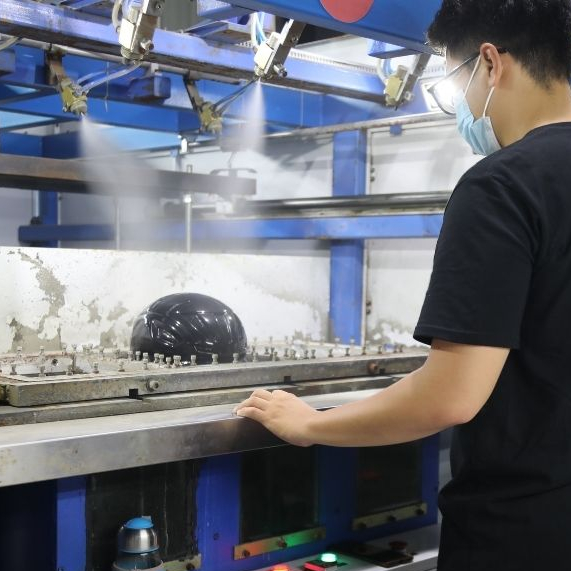
During the vacuum-forming process, a polycarbonate sheet is securely positioned and heated until it reaches the appropriate forming condition.

The softened sheet is then drawn against a custom forming mold using vacuum pressure. As air is removed between the material and the mold, the PC sheet follows the engineered surface geometry of the tool.

After forming, the material is cooled, removed from the mold, trimmed and inspected.

The basic process is:

PC Sheet Preparation → Printing → Heating → Vacuum Forming → Cooling → Trimming → Inspection

Vacuum forming is a well-established thermoforming method for producing three-dimensional plastic components. Polycarbonate films can combine toughness, formability and high-quality printable surfaces, making them particularly useful when both structural and appearance requirements are important.

Why Polycarbonate for Helmet Shells?

Polycarbonate is widely used in modern helmet construction because it provides a useful combination of toughness, low weight, formability and surface design flexibility.

Excellent Design Flexibility

Vacuum forming allows PC sheets to follow complex curved surfaces, ventilation openings and helmet geometries.

This gives helmet designers considerable freedom when developing modern aerodynamic and highly ventilated helmet shapes.

High-Quality Graphics & Surface Finish

One of the major advantages of transparent or printable PC film is the ability to incorporate colors, patterns, logos and other graphics before forming.

Printed graphics can then be shaped together with the shell, allowing the decorative design to follow the three-dimensional helmet surface.

Polycarbonate films are available in transparent, translucent, opaque and colored configurations and can support high-quality printing depending on the material selected.

Lightweight Construction

Thin PC sheets can be formed into complex helmet-shell geometries while keeping the overall shell lightweight—an important consideration for bicycle and performance helmet applications.

(Type of mesh, Squeegee, Stencil, these are most important variables for the printing of polycarbonate sheet. Of course, the amount of printing oil will determine the final graphics on the sheets.)

High Impact Resistance & Toughness

Polycarbonate is known for its toughness and impact-resistant properties, making it suitable for demanding protective and industrial applications. Specific performance depends on the selected material grade, thickness and finished-product construction.

Precision Forming Starts With the Tooling

A high-quality vacuum-formed shell depends on more than the forming machine.

Tooling accuracy, material thickness, heating control, forming temperature, vacuum distribution, cooling and trimming all influence the finished component.

At Aurora Sports, our tooling and manufacturing teams consider these factors during product development to help achieve stable geometry and repeatable production.

For helmet shells, particular attention must be given to:

  • Shell geometry
  • Material thickness
  • Vent locations
  • Forming depth
  • Edge definition
  • Graphic positioning
  • Mold surface quality
  • Trimming accuracy
  • Fit with the EPS mold
  • Production consistency

This is particularly important for in-mold helmet manufacturing, where the formed PC shell must correctly match the EPS tooling and helmet geometry during the subsequent molding process.

From Printed PC Sheet to In-Mold Helmet

For many lightweight bicycle helmets, vacuum forming is only one step in a larger manufacturing process.

After the PC sheet is printed and vacuum formed, the shell is precisely trimmed and prepared for EPS in-mold production.

The completed shell is positioned inside the EPS mold, where the EPS liner is subsequently formed against it.

This creates the integrated PC shell + EPS liner construction commonly used in modern lightweight cycling helmets.

At Aurora, our experience across both polycarbonate vacuum forming and EPS in-mold manufacturing allows these processes to be considered together during helmet development.

Applications of Polycarbonate Vacuum Forming

Aurora’s vacuum-forming capabilities can support a range of helmet and protective-product applications, including:

  • Bicycle helmet shells
  • Children’s helmet shells
  • Skate helmet components
  • Equestrian helmet shells
  • Snow sports helmet shells
  • Outdoor sports helmets
  • Protective equipment components
  • Custom thermoformed plastic parts

The same thermoforming principles can also be used for suitable custom applications in consumer products, electronics, equipment housings, displays, packaging and other formed-plastic products, depending on material and project requirements.

Vacuum Forming as Part of Aurora’s Manufacturing System

At Aurora, polycarbonate vacuum forming is not an isolated production process.

It is integrated into our broader product-development and manufacturing capabilities:

Concept → Industrial Design → Engineering → Prototype → Tooling → Graphic Development → Vacuum Forming → EPS In-Mold / Assembly → Quality Control → Mass Production

By bringing these processes together, our engineers can consider how the formed component will interact with the complete product from the beginning of development.

For helmet projects, this can include coordination between:

  • Industrial design
  • PC shell engineering
  • Graphic development
  • Forming-tool design
  • EPS tooling
  • In-mold production
  • Component integration
  • Testing
  • Assembly
  • Quality control

The goal is not simply to form a plastic shell.

The goal is to develop a shell that works correctly within the complete product and can be manufactured consistently at scale.

Click here to add your own text

Custom Polycarbonate Vacuum Forming With Aurora

With more than three decades of manufacturing experience, Aurora Sports supports customers from initial product concepts through tooling and mass production.

Whether you already have a CAD file, drawing, existing sample or new product idea, our team can evaluate the project and determine the appropriate material, tooling and forming process.

For helmet brands, our integrated capabilities in PC vacuum forming, custom graphic printing, EPS in-mold technology, plastic injection molding, tooling, assembly and quality control provide a complete development and production solution.

Looking for a Polycarbonate Vacuum Forming Manufacturer?

Talk to Aurora Sports about your next custom helmet shell, thermoformed PC component or OEM/ODM product development project.

Ready to discuss your project?
Contact Aurora with a general overview of your requirements. For projects involving confidential designs or proprietary information, an NDA can be established before any CAD files, drawings, samples, or technical documents are shared.