
Helmet Size Testing Explained: Headforms, Fit Systems & Roll-Off Testing
Why Helmet Size Matters in Safety Testing
Small, medium, and large may look like simple labels on a helmet box—but helmet sizing becomes much more technical once engineering and safety testing begin.
A helmet must do more than simply fit around a certain head circumference. It must sit in the correct position, provide the intended protective coverage, remain stable, work correctly with its retention and adjustment systems, and manage impact energy across its declared size range.
That is why laboratories use standardized headforms, identified by letters, rather than people wearing helmets, to perform controlled and repeatable tests.
At Aurora Sports, helmet sizing is considered throughout:
Industrial Design → CAD Engineering → Fit-System Development → Tooling → Sampling → Testing → Certification Support → Mass Production
And for industrial safety helmets in particular, sizing presents an interesting engineering challenge.
Consumer Helmet Sizes and Laboratory Headforms Are Not the Same Thing
Consumers are familiar with labels such as:
XS | S | M | L | XL
These labels help buyers choose a helmet, but they are not universal measurements.
A medium helmet from one brand or helmet category may cover a different head-circumference range from a medium made by another manufacturer.
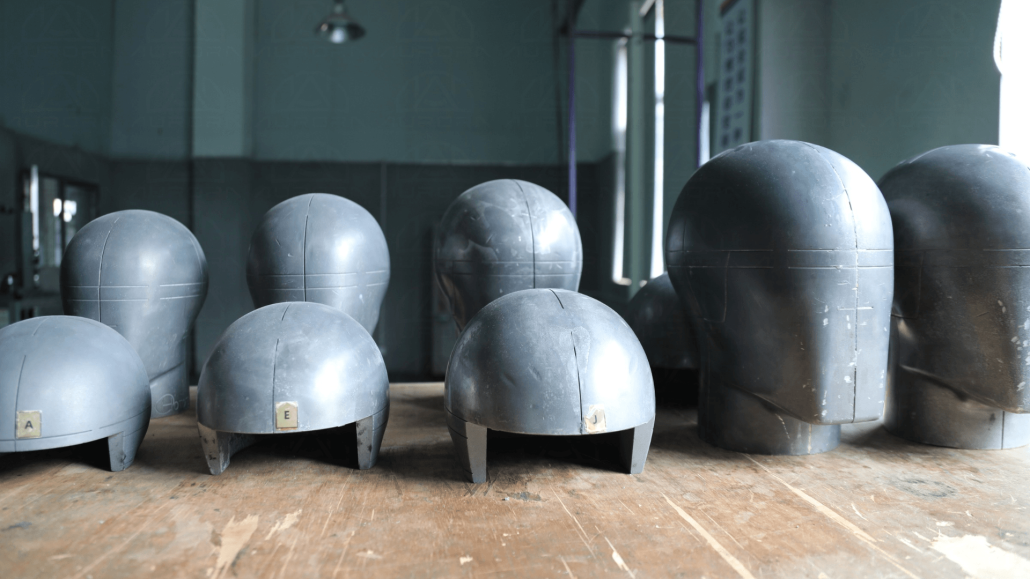
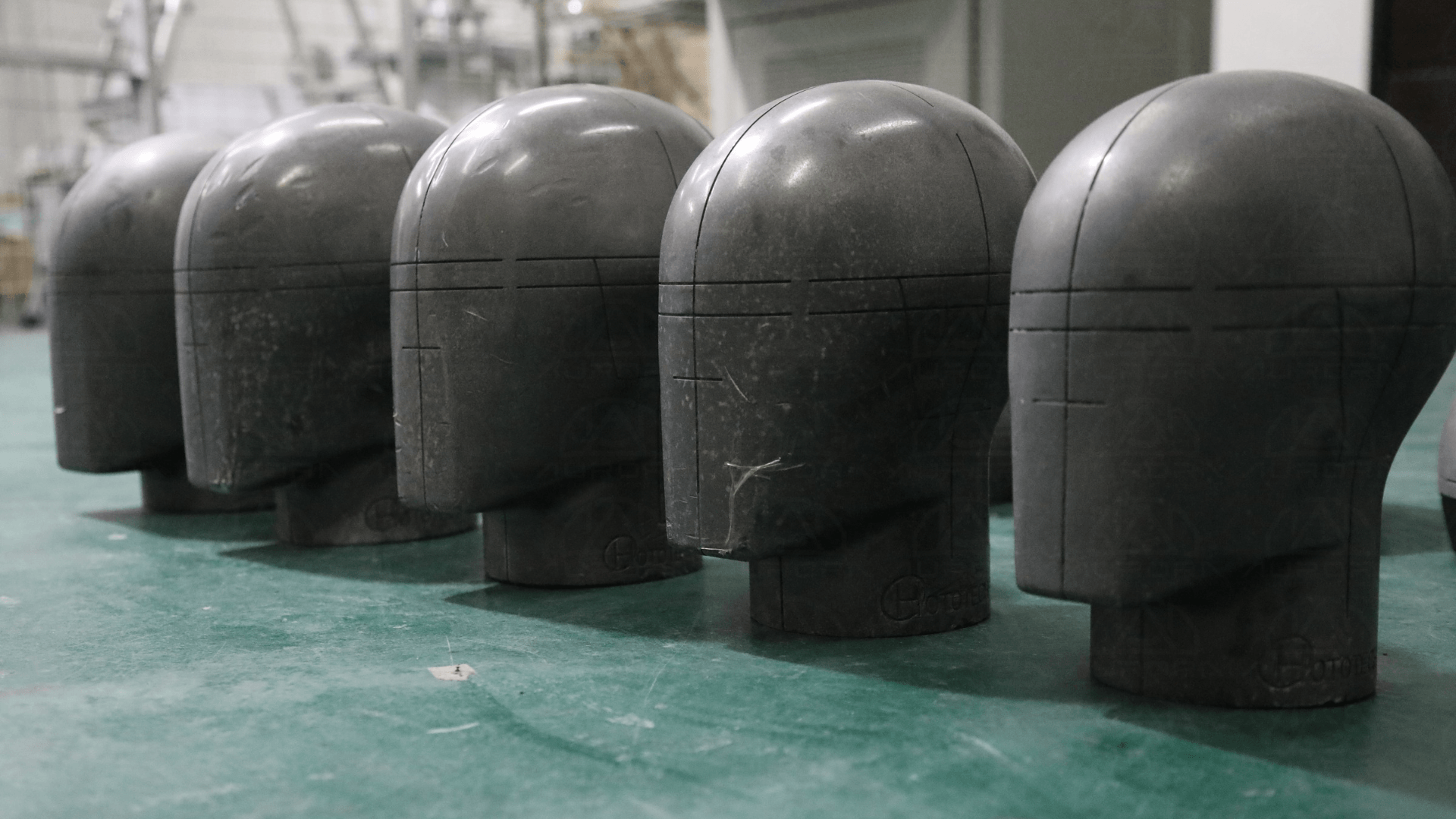
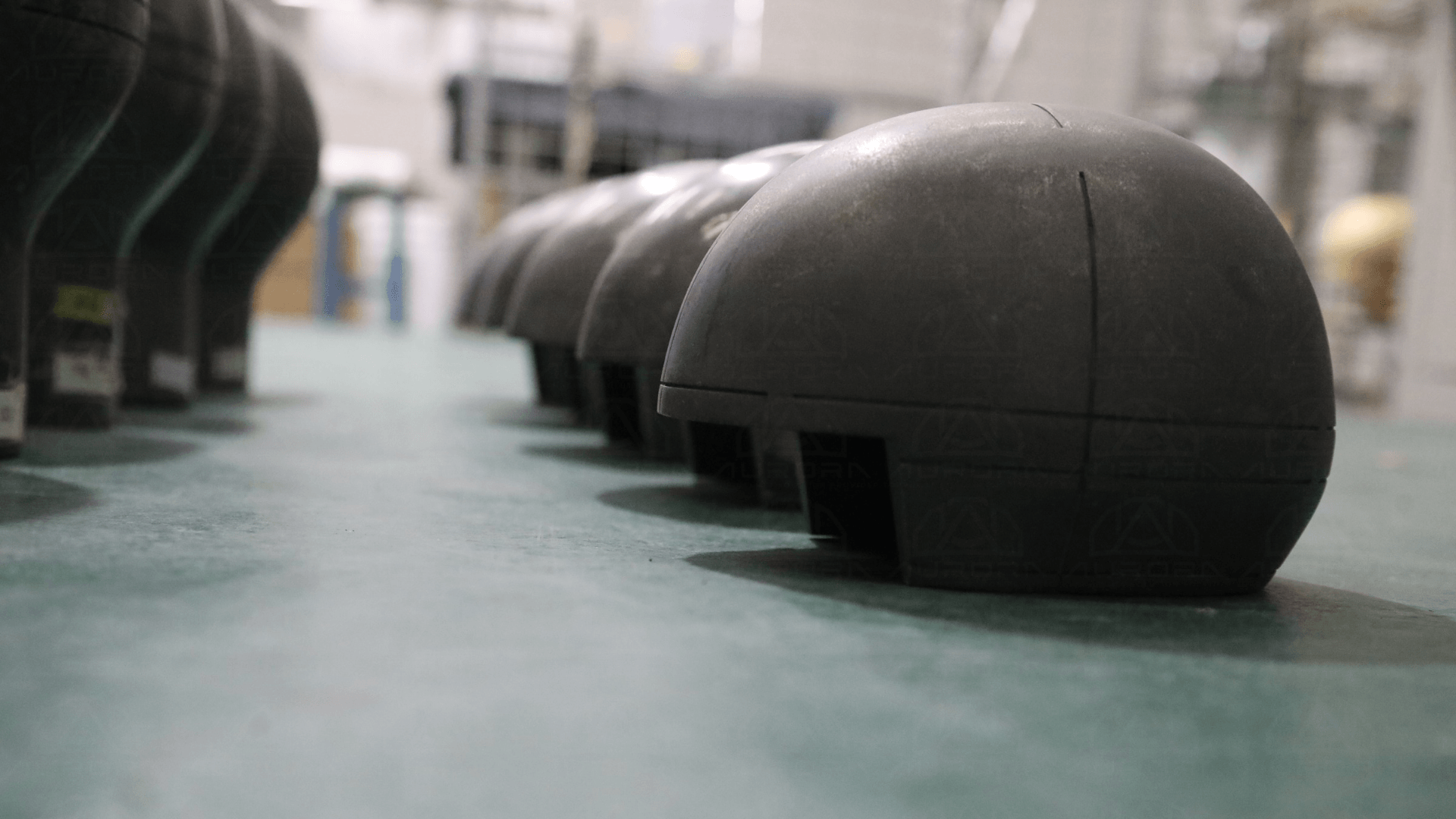
Testing laboratories therefore use standardized rigid headforms representing defined head dimensions.
Common headform designations include:
| Headform | Nominal Circumference | General Size Orientation |
|---|---|---|
| A | 50 cm | Extra small |
| C | 52 cm | Small |
| E | 54 cm | Small to medium |
| J | 57 cm | Medium |
| M | 60 cm | Large |
| O | 62 cm | Extra large |
These descriptions are only intended to help illustrate the approximate size progression.
The letters identify laboratory headforms—not retail helmet sizes.
The required headform depends on:
- Helmet category
- Declared size range
- Applicable testing standard
- Target market
- Specific test procedure
Why Does Helmet Size Matter in Testing?
A helmet may be offered in several sizes, but different sizes do not necessarily behave identically.
Changing the shell, impact liner, padding, suspension, or internal dimensions can affect:
- Material thickness
- Impact-liner geometry
- Vent positioning
- Protective coverage
- Helmet position
- Strap geometry
- Fit-system operation
- Component clearances
- Accessory compatibility
- Overall helmet mass
- Positional stability during roll-off testing
A smaller helmet is therefore not always simply a scaled-down version of a larger helmet.
Each intended production configuration needs to be evaluated appropriately.
How Is the Correct Headform Selected?
Headform selection starts with the helmet’s declared fitting range.
The applicable standard then determines which headform or headforms should be used.
Depending on the procedure, the helmet may be evaluated on:
- The smallest appropriate headform
- The largest appropriate headform
- Multiple headforms representing different parts of the declared range
- A specific headform selected according to the helmet’s adjustment capability
The helmet is positioned according to the defined test procedure before measurements or performance tests begin.
This matters because the same helmet can behave differently depending on where it sits on the headform.
What Is Actually Evaluated?
The exact requirements vary among bicycle, climbing, equestrian, snow-sports, motorcycle, industrial, and other helmet categories.
Depending on the applicable standard, size-related testing may include several areas.
Fit and Positioning
The helmet is placed on the appropriate headform according to the required positioning method.
Engineers evaluate whether the helmet sits at the intended:
- Height
- Angle
- Front-to-back position
- Side-to-side position
The shell, liner, padding, suspension, and fit system all influence the final position.
Protective Coverage
Once the helmet is correctly positioned, test lines or protective boundaries may be established.
These help determine the areas in which impact testing can occur and whether the helmet provides the required protective coverage.
A change in helmet size or internal geometry can change how the helmet sits—and therefore how its protective area relates to the headform.
Impact Attenuation
During impact testing, the helmet is mounted on an instrumented headform and subjected to controlled impacts against specified anvils.
Sensors measure the acceleration transmitted through the helmet system.
The purpose is not simply to determine whether the outer shell is strong.
The test evaluates how the complete helmet manages impact energy through the combined behavior of:
Shell + Impact Liner or Suspension + Geometry + Fit + Retention System
Positional Stability and Roll-Off Testing
This is another area where helmet size and fit can matter significantly.
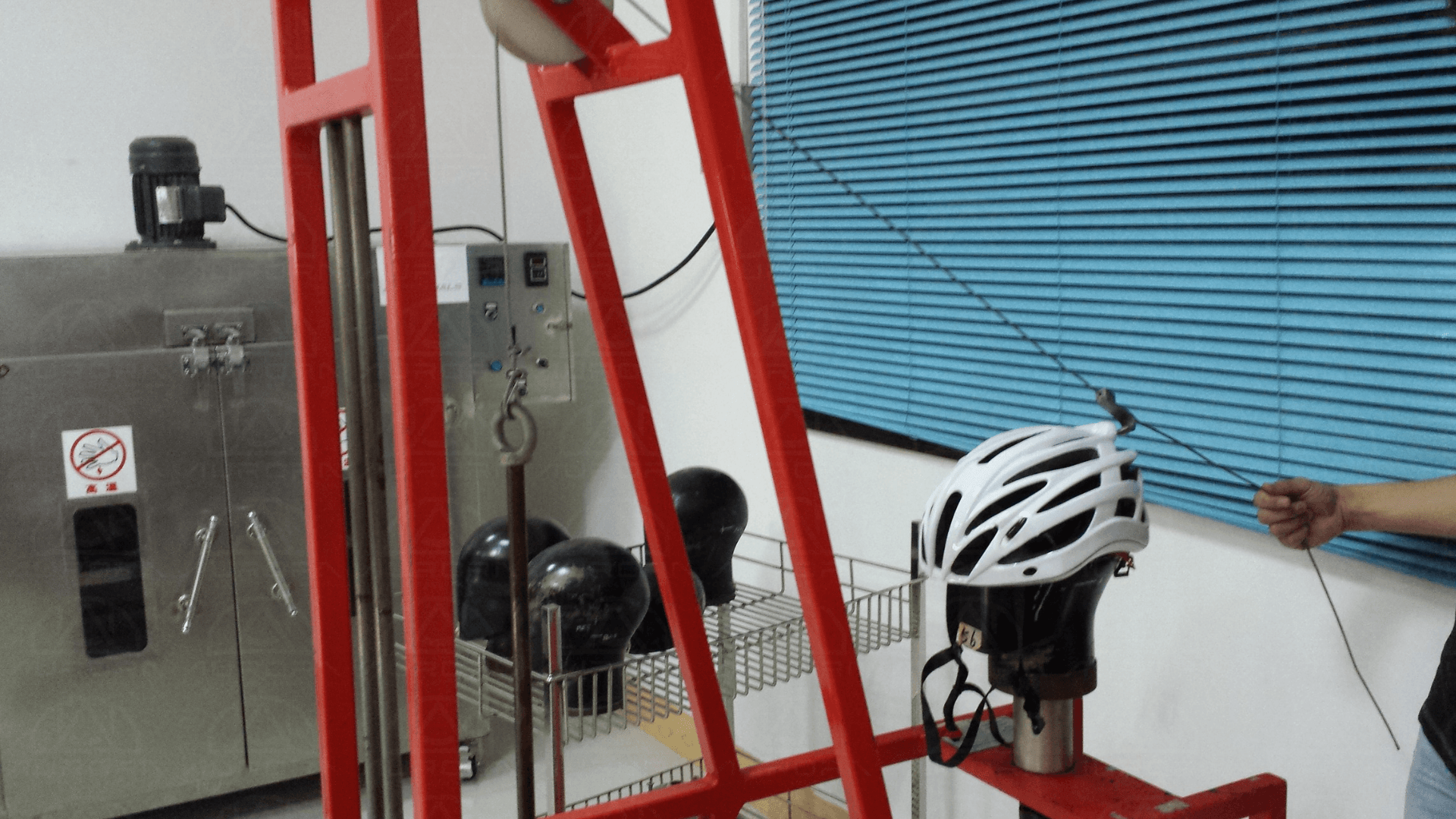
Roll-off testing evaluates whether the helmet remains properly positioned on the headform when a specified force is applied.
A helmet may fit securely in the middle of its adjustment range but behave differently when adjusted near the smallest or largest end of that range.
For example, on a smaller headform:
- The fit system may need to contract significantly
- The helmet may sit higher
- Rear support may change position
- Strap geometry may change
- Additional internal space may allow greater movement
On a larger headform:
- The adjustment system may approach its maximum range
- Internal clearance may decrease
- Strap angles may change
- The helmet may sit differently relative to the crown and rear of the head
These differences can influence how effectively the helmet resists movement during a roll-off test.
This is why a broad circumference range alone does not prove that a helmet will remain equally stable across that entire range.
Adjustment range and positional stability must work together.
Retention-System Performance
The chin strap, webbing, buckles, anchors, and related retention components may also be subjected to controlled loading.
Depending on the standard, the test can evaluate:
- Retention strength
- Elongation
- Buckle performance
- Anchor performance
- Helmet stability
The geometry of the retention system can change depending on the head size and helmet position.
Vision and Clearance
Some standards also evaluate peripheral vision or other required clearances.
Helmet size, shell depth, padding thickness, accessories, and internal positioning can all affect the wearer’s field of view or available clearance.
Sports Helmets and Safety Helmets Approach Sizing Differently
This is where the subject becomes especially interesting.
In many sports-helmet categories, multiple consumer sizes are common.
A helmet may be manufactured in:
Small | Medium | Large
or perhaps:
S/M | M/L
For helmets using constructions such as PC shells with EPS impact liners, different shell and EPS tooling can be developed for different size ranges.
This gives designers the opportunity to optimize each size more closely around a narrower group of users.
The shell, EPS liner, padding, and fit system can all be adjusted for that particular size range.
But What About Industrial Safety Helmets?
Industrial safety helmets often present a different challenge.
Look at many safety helmets in the market and you will notice something interesting:
One helmet model often covers a very broad head-size range.
Instead of offering several completely different helmet sizes, many safety helmets rely heavily on an adjustable internal suspension or fit system.
This creates an important engineering question:
How can one helmet accommodate both a smaller head and a much larger head?
The answer is not simply:
“Make the ratchet adjustment longer.”
A successful adjustable safety helmet requires the entire internal architecture to work across the intended range.
One Shell Does Not Mean One Fixed Fit
The outer shell may remain the same size, but the internal system changes position around the wearer’s head.
Depending on the design, the helmet may use:
- Adjustable headband
- Ratchet or dial system
- Front support
- Rear support
- Nape support
- Suspension webbing
- Height adjustment
- Comfort padding
- Chin strap
- Multiple anchor points
All of these components influence how the helmet fits.
The challenge is making them work correctly at both ends of the adjustment range.
Small Head vs. Large Head: The Geometry Changes
Imagine one safety helmet designed to cover a broad head-circumference range.
When fitted to a smaller head, the adjustment system closes inward.
But several questions remain:
- Does the helmet sit too high?
- Does it move excessively?
- Does the rear support properly contact the head?
- Does the chin strap remain correctly positioned?
- Does the helmet resist roll-off effectively?
- Does the worker experience pressure points?
- Does the shell remain properly centered?
Now adjust the same helmet for a much larger head.
Different questions appear:
- Is sufficient adjustment travel available?
- Does the helmet become too tight?
- Is internal clearance reduced?
- Does the fit system interfere with the shell or liner?
- Does strap geometry change?
- Does the helmet remain stable during roll-off testing?
- Does the helmet still sit at the intended height?
This is why adjustment range alone does not define good helmet fit.
Why Roll-Off Testing Is Especially Important for Broad-Range Safety Helmets
For a safety helmet intended to fit a wide range of head sizes, roll-off performance can reveal problems that a simple circumference measurement cannot.
A helmet may tighten around the head and appear to fit, yet still move excessively when subjected to directional force.
That movement can be influenced by:
Headform Size + Helmet Position + Rear Support + Headband Geometry + Chin Strap + Anchor Location + Suspension Design
This makes roll-off testing particularly relevant when evaluating a universal or broad-range safety helmet.
The engineering question is not simply:
“Can the helmet adjust from 52 cm to 63 cm?”
It is also:
“Does the helmet remain properly positioned and stable throughout that intended range?”
That is a much more meaningful measure of fit-system performance.
Helmet Size Is About More Than Circumference
Two people can have the same head circumference and still have noticeably different head shapes.
Important dimensions can include:
- Head width
- Front-to-back length
- Crown height
- Temple width
- Occipital shape
- Forehead geometry
That means two people with identical circumference measurements may experience the same helmet very differently.
One may find it comfortable.
The other may experience:
- Pressure at the temples
- Excess front-to-back movement
- Incorrect helmet height
- Rear instability
- Poor strap positioning
This is why helmet development needs to consider head shape as well as circumference.
The Fit System Becomes Part of the Helmet Engineering
For industrial safety helmets covering a broad size range, the fit system is not simply a comfort accessory.
It influences the complete helmet architecture.
Engineers may need to consider:
Circumference Adjustment + Front-to-Back Fit + Wearing Height + Rear Support + Strap Geometry + Internal Clearance + Stability + Roll-Off Performance
Changes to the fit system can also affect:
- Padding
- Ventilation
- Suspension geometry
- Chin-strap positioning
- Accessory interfaces
- Internal space
- Helmet balance
That is why Aurora Sports considers fit-system development early in the helmet-development process.
What If One Shell Covers Multiple Consumer Sizes?
Some helmets use one shell or one primary shell/liner architecture while offering different consumer-size configurations through:
- Different padding thicknesses
- Different comfort liners
- Adjustable fit systems
- Different suspension settings
This can be an efficient product strategy.
However, it does not mean size evaluation can be skipped.
The development team still needs to confirm:
- Intended circumference range
- Padding configuration
- Fit-system adjustment range
- Helmet stability
- Roll-off behavior
- Protective coverage
- Headform requirements
- Strap geometry
- Internal clearance
- Production consistency
Every test sample should accurately represent the intended production configuration.
A Broad Adjustment Range Is Not the Whole Answer
It may sound impressive for a helmet to cover a very large circumference range.
But the real engineering question is:
Does the helmet fit and perform correctly throughout that range?
A helmet may technically tighten around a smaller head while still sitting incorrectly or moving excessively during roll-off evaluation.
Likewise, it may technically expand around a larger head but create insufficient clearance, uncomfortable pressure, or different retention geometry.
The goal should therefore be more than simply achieving a large numerical adjustment range.
The goal is:
Fit + Position + Stability + Roll-Off Resistance + Coverage + Retention + Comfort
across the intended user population.
Size Development Should Begin Before Tooling
Helmet sizing should not be decided only after the shell design is finished.
Ideally, size strategy is considered during early development.
A typical development sequence may include:
Target User Population → Head Circumference Range → Headform Analysis → Fit-System Strategy → Internal Geometry → CAD Engineering → Tooling → Initial Samples → Fit & Roll-Off Evaluation → Safety Testing → Corrections → Production-Intent Samples
This allows the shell, liner, suspension, padding, retention system, and adjustment mechanism to be developed as one coordinated system.
Testing Different Sizes Before Mass Production
Initial samples provide an opportunity to evaluate how the intended size strategy works physically.
Depending on the project, Aurora Sports may review:
- Shell geometry
- Impact-liner geometry
- Suspension geometry
- Adjustment range
- Padding thickness
- Wearing height
- Strap position
- Rear-head support
- Internal clearance
- Accessory compatibility
- Overall stability
- Roll-off behavior across appropriate headforms
If a concern is identified, the team can return to:
Engineering → Tooling → Components → Fit System → Assembly
before mass production begins.
Laboratory Headforms and Human Fit Testing Serve Different Purposes
Standardized headforms are extremely important because they allow laboratories to perform repeatable and comparable tests.
But laboratory headforms cannot represent every human head shape.
That is why helmet development may also include:
- Wear trials
- Regional fit evaluation
- User feedback
- Fit-system testing
- Adjustment-range evaluation
Laboratory testing evaluates standardized safety performance.
Human fit evaluation helps engineers understand the actual wearing experience.
Both perspectives are valuable.
Safety Helmet Sizing Deserves More Attention
For sports helmets, consumers are already accustomed to selecting among multiple helmet sizes.
Industrial safety helmets often ask a single adjustable helmet configuration to accommodate a much broader group of users.
That makes safety-helmet sizing a particularly interesting engineering problem.
The question is not simply:
“What circumference does this helmet fit?”
A better question is:
“How well does the complete helmet system fit, stay positioned, and perform across its intended range?”
At Aurora Sports, we continue to study:
- Helmet sizing
- Headform differences
- Internal geometry
- Fit-system design
- Adjustment mechanisms
- Size-specific performance
- Retention and stability
- Roll-off behavior
- User comfort
as part of our broader helmet-development work.
The objective is to continue improving how helmets accommodate different users while maintaining the performance expected from the complete protective system.
Developing Helmet Sizes With Aurora Sports
Aurora Sports can support helmet sizing as part of a coordinated OEM/ODM development process:
Target Size Range → Headform & Fit Evaluation → Industrial Design → CAD Engineering → Fit-System Development → Tooling → Initial Samples → Size & Roll-Off Evaluation → Testing → Corrections → Production-Intent Samples → Certification Support → Mass Production
Depending on the project, our team can work with:
- Shell and liner geometry
- Suspension systems
- Padding
- Ratchet and dial systems
- Headband structures
- Chin straps
- Internal clearances
- Accessory integration
- Multiple intended fit ranges
The final testing strategy always depends on the helmet category, target market, and applicable standard.
Not every headform, size strategy, roll-off procedure, or test method applies to every helmet.
Different Heads. Different Sizes. One Consistent Goal.
Helmet sizing is much more than choosing between S, M, and L.
It affects:
Fit. Positioning. Coverage. Stability. Roll-Off Performance. Retention. Comfort. Impact Performance.
For safety helmets in particular, accommodating a broad range of users within a carefully engineered helmet system presents unique development challenges.
Understanding those challenges early can help manufacturers develop better fit systems, better internal geometry, greater positional stability, and more consistent helmet performance before production is scaled.
Planning a new helmet project?
Contact Aurora Sports to discuss helmet sizing, fit-system development, headform evaluation, roll-off testing support, initial sample testing, certification support, and ODM/OEM helmet manufacturing.
Contact Us:
📱: +1 (657) 762-7550
📧 : sales@aurorasport.com


