Helmet Adjusters: The Small Component That Makes a Big Difference
A helmet can only perform as intended when it fits correctly and remains securely positioned on the wearer’s head.
That is why the helmet adjuster—also known as a helmet fit system, retention system, headlock, or dial-fit system—is such an important part of helmet development.
Although it may appear to be a relatively small component, the adjuster can have a major influence on comfort, stability, sizing, ventilation, weight, usability, and the overall user experience.
At Aurora Sports, we work with brands to select, integrate, customize, and develop helmet adjusters for a wide range of sports and safety helmet applications.
More Than Just a Dial
A well-designed helmet adjuster does much more than simply tighten the helmet.
It can help:
- Distribute pressure more evenly around the head
- Improve helmet stability during movement
- Fine-tune the fit for different head shapes
- Adjust helmet height and positioning
- Improve comfort during extended use
- Maintain proper alignment between the helmet, straps, and padding
- Support easier replacement and after-sales service
Depending on the application, the fit system can also influence the helmet’s interior architecture, ventilation channels, shell and EPS design, strap configuration, appearance, and overall product positioning.
For this reason, we recommend considering the adjuster early in the helmet development process rather than treating it as a component to select at the end.
Helmet Fit-System Options
Aurora Sports offers a broad range of helmet adjuster solutions for applications including:
- Bicycle helmets
- Children’s helmets
- Climbing helmets
- Skate helmets
- Equestrian helmets
- Short-track and sports helmets
- Industrial and safety helmets
- Other custom helmet applications

Depending on the product requirements, available features can include:
Rotating Dial Adjustment
Dial-fit systems allow users to quickly tighten or loosen the helmet, with many designs offering convenient one-handed operation while the helmet is being worn.
Vertical & Multi-Axis Adjustment
More advanced systems can provide vertical, fore-and-aft, or 3-axis adjustment, allowing the user to fine-tune helmet height, tilt, and retention tension.
Lightweight Fit Structures
For performance-oriented helmets, lightweight floating structures can reduce unnecessary bulk while maintaining comfort and stability.
Replaceable Fit Systems
A replaceable adjuster can make after-sales service easier by allowing worn or damaged components to be changed without replacing the entire helmet.
Enhanced Dial Grip
Rubber-overmolded dials, thumb wheels, and other textured designs can improve grip and make adjustment easier, including when wearing gloves.
Reflective & LED Features
For commuter, cycling, and visibility-focused applications, fit systems can incorporate reflective elements or optional LED lighting with steady or flashing modes.
Webbing & Bracket Integration
Different bracket and webbing configurations can help maintain helmet position and improve alignment between the adjustment system and the retention straps.
Multiple Size Configurations
Fit systems can be developed around different head-size ranges, including applications for children, adults, and different regional headforms.
Logo & Brand Customization
Logos, colors, dial graphics, finishes, and other visual details can be customized to strengthen the overall brand identity of the helmet.
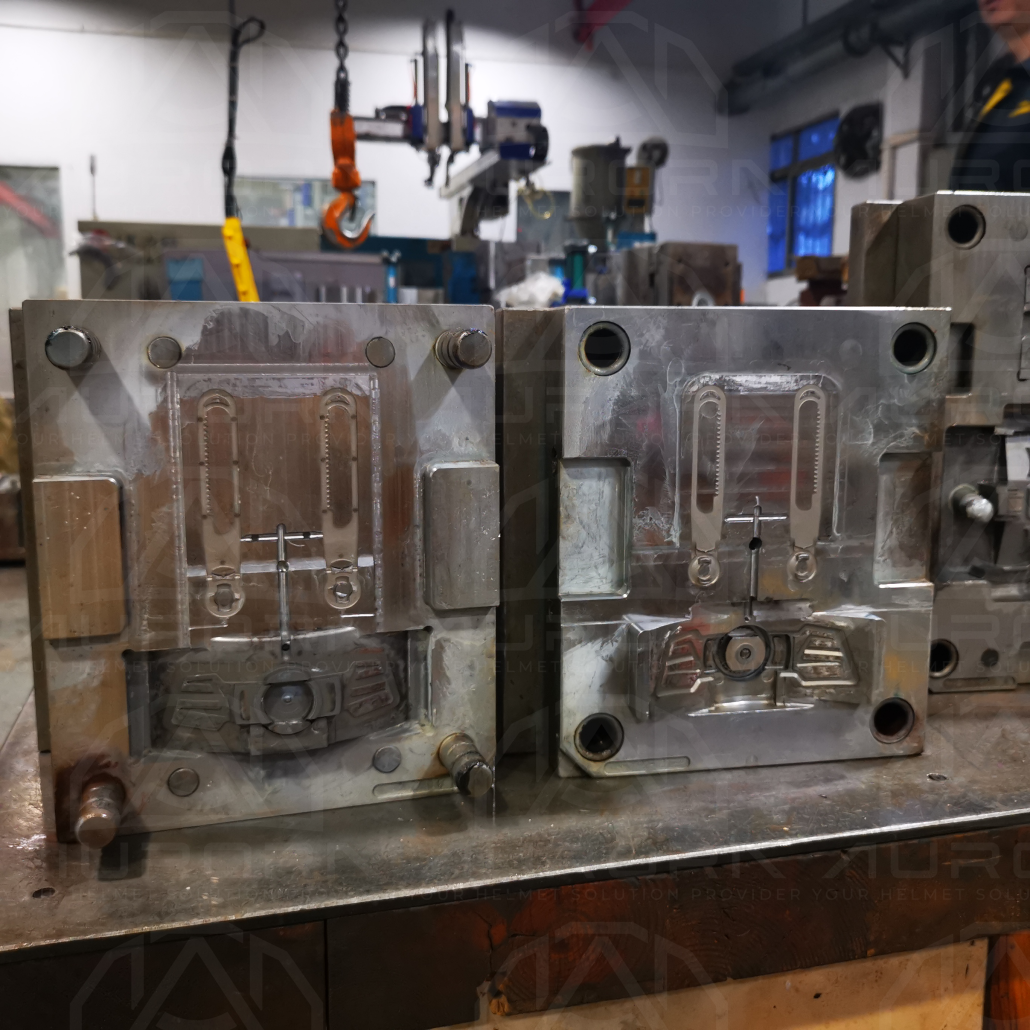
Open-Mold Helmet Adjusters for Faster Development
Not every helmet project requires a completely new fit system.
Aurora Sports has a range of open-mold helmet adjusters that can provide brands with an efficient starting point for new product development.
Using an existing adjuster can help reduce:
- Development time
- Tooling investment
- Initial engineering cost
- Prototype iterations
- Time to market
An open-mold solution can be particularly useful for brands that want to:
- Launch a new helmet efficiently
- Test a new product category
- Expand an existing helmet line
- Compare different fit-system concepts
- Reduce initial tooling investment
Depending on the project, an existing adjuster may also be customized through changes to color, materials, sizing, branding, webbing, padding interfaces, dial design, or other compatible components.
Open Mold or Custom Development?
The right choice depends on the project.
If an existing adjuster already meets the product’s fit, performance, cost, and design requirements, an open-mold solution can be the most efficient path.
If the helmet requires a distinctive fit experience, unique geometry, specialized adjustment range, proprietary styling, or deeper integration into the helmet structure, a custom OEM/ODM adjuster may be more appropriate.
Aurora can help evaluate both directions before major tooling investment begins.

OEM/ODM Helmet Adjuster Development
Aurora Sports is an experienced OEM/ODM helmet manufacturer, which means our work can extend beyond supplying existing components.
We can collaborate with customers to develop a fit system specifically around the requirements of a new helmet.
OEM Development
For OEM projects, Aurora can manufacture according to the customer’s established design, specifications, drawings, or performance requirements.
ODM Development
For ODM projects, our team can support development from an earlier stage, helping transform an idea, reference product, sketch, functional requirement, or design direction into a manufacturable helmet fit system.
Depending on the project, development may include:
- Adjuster structure and geometry
- Integration with shell and EPS architecture
- Head-size range
- Vertical and multi-axis adjustment
- Dial shape and ergonomics
- Adjustment force and incremental feel
- Material selection
- Weight optimization
- Durability and serviceability
- Replaceable component design
- Webbing and bracket integration
- Padding compatibility
- LED or reflective features
- Color and surface finish
- Logo customization
- Prototype development
- Tooling
- Testing support
- Pilot production
- Mass production
Protecting Your Design with an NDA
We understand that many helmet-development projects involve confidential product concepts, proprietary mechanisms, CAD files, drawings, prototypes, and unreleased product plans.
Before sharing sensitive information, customers are welcome to put a Non-Disclosure Agreement (NDA) in place with Aurora.
If your company already has an NDA, our team can review it. Alternatively, Aurora can provide our standard NDA template for your review.
Once the confidentiality agreement is established, your team can share more detailed information with us so our engineers can evaluate the project properly.
This is especially important for custom adjuster development involving:
- Proprietary adjustment mechanisms
- New mechanical structures
- Custom helmet architecture
- Patent-pending concepts
- Unreleased products
- Confidential CAD or STEP files
- Competitive reference products
- Brand-specific design features
Our goal is to create an environment where customers can discuss their development needs openly while protecting the intellectual property involved in the project.

Choosing the Right Adjuster for Your Helmet
There is no single fit system that is ideal for every helmet.
The most suitable adjuster depends on factors such as:
Target user Children, recreational users, professional athletes, industrial workers, and other user groups may require very different adjustment systems.
Headform and size range Different markets and helmet categories may require different internal geometries and adjustment ranges.
Activity and movement A performance sports helmet may require greater stability and lower weight, while an industrial helmet may prioritize durability and glove-friendly operation.
Helmet architecture The shell, EPS liner, ventilation channels, padding, webbing, and fit system must work together as one complete system.
Target price A simple dial system may be appropriate for an entry-level helmet, while premium products may benefit from multi-axis adjustment, lightweight construction, or additional features.
Serviceability For products intended for long-term professional use, replaceable components can provide additional value.
Brand positioning A distinctive fit system can become an important part of the customer’s experience and help differentiate one helmet from another.
The Adjuster Should Be Designed as Part of the Helmet
One of the most important lessons in helmet development is that individual components should not be considered in isolation.
The adjuster interacts with:
- Shell geometry
- EPS liner
- Comfort padding
- Retention straps
- Headform
- Ventilation
- Accessories
- Weight distribution
- Overall helmet balance
A successful fit system is therefore not simply the best adjuster on its own—it is the adjuster that works best with the complete helmet.

By evaluating the fit system early, brands can reduce the risk of compatibility problems later in tooling, testing, or mass production.
Build a Better Helmet Fit System with Aurora Sports
Whether you need an efficient open-mold helmet adjuster or want to develop a completely customized fit system for a new product line, Aurora Sports can support the process from component selection and engineering through prototyping, tooling, testing support, and mass production.
With decades of helmet development and manufacturing experience, our goal is to help customers create products that are not only protective, but also comfortable, stable, intuitive to use, manufacturable, and differentiated in the market.
Have a Helmet Adjuster Concept?
If you already have a concept, drawing, reference, CAD file, or performance requirement, contact our team to discuss the project.
An NDA can be arranged before confidential design information is shared.
Let’s develop a helmet fit system that works not only as a component—but as part of a better helmet.
Contact Us:
📱: +1 (657) 762-7550


